 111
111 2
2 3
3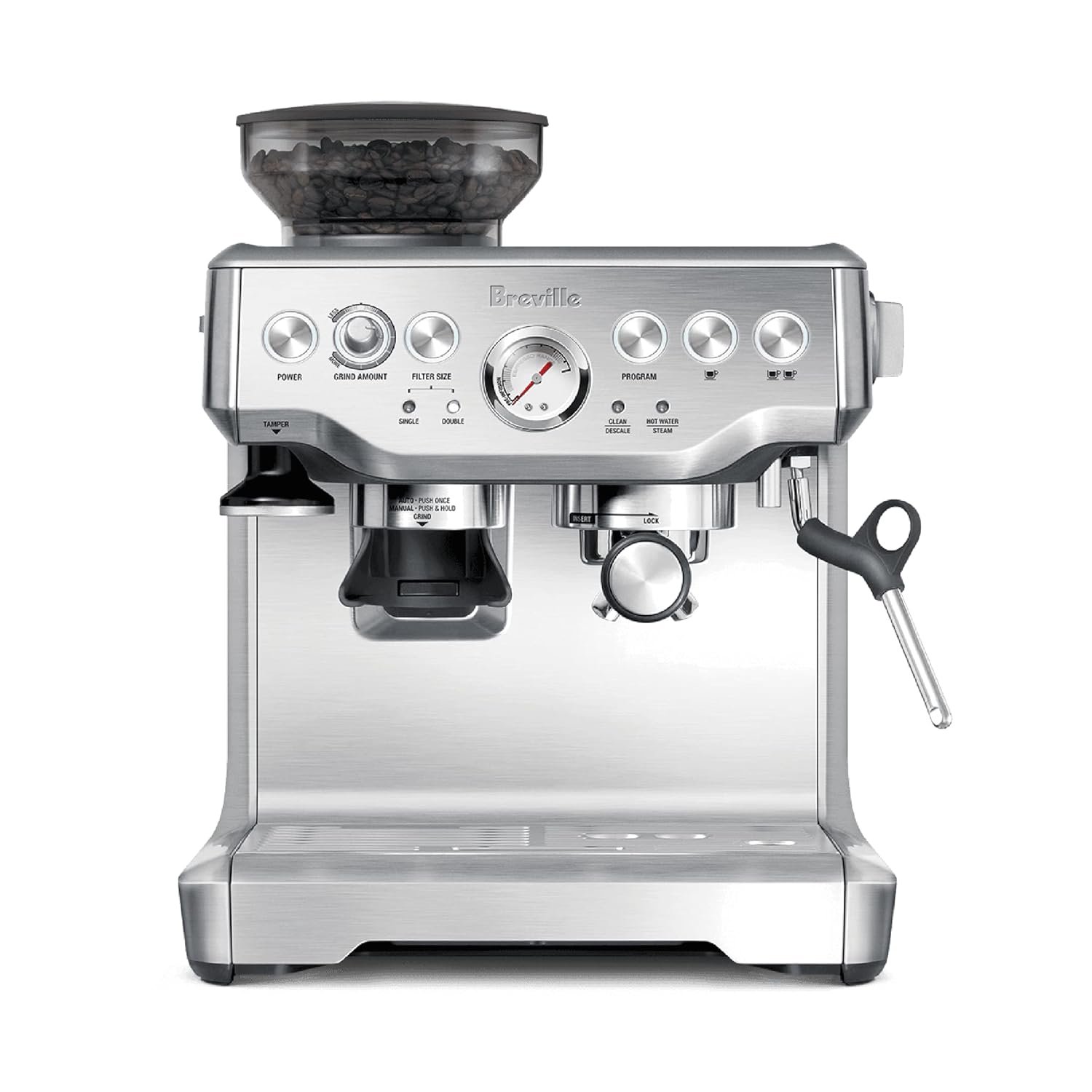
For many coffee enthusiasts, the daily ritual of enjoying a rich, velvety espresso or a perfectly textured latte is non-negotiable. While frequenting local cafes is a delightful habit, the desire to replicate that authentic barista experience at home leads many to explore the world of semi-automatic espresso machines.
The Breville Barista Express Espresso Machine (BES870XL) in Brushed Stainless Steel has long stood as a benchmark in the home espresso category. Designed to bridge the gap between novice brewing and professional-grade extraction, this all-in-one machine provides the tools necessary to transform raw coffee beans into cafe-quality beverages.
This comprehensive guide explores the design, technical capabilities, and day-to-day operation of the BES870XL, offering a detailed look into how it manages the complex variables of espresso orchestration.
Breville has established a distinct design language characterized by utilitarian elegance, and the BES870XL is a prime example. Clad in brushed stainless steel, the machine projects a professional aesthetic that complements modern kitchen environments while resisting the wear and tear of daily use.
Weighing in at approximately 23 pounds and measuring 12.5 x 12.6 x 13.1 inches, the Barista Express is a substantial piece of equipment. This heft is intentional; it provides a stable foundation when locking the portafilter into the group head—a process that requires manual force. The chassis utilizes a combination of heavy-duty stainless steel and high-grade, BPA-free plastics in the internal plumbing and structural accents, balancing durability with thermal management.
The user interface avoids overly complex digital menus in favor of tactile buttons and a prominent, centrally located pressure gauge. The control layout is sequential, guiding the user logically from left to right through the espresso-making process:
To understand what happens beneath the stainless steel exterior, it helps to examine the core engineering specifications that drive the Barista Express:
| Feature | Specification |
| Heating System | 1600W Thermocoil (Integrated Stainless Steel Water Coil) |
| Pump Pressure | 15-Bar Italian Pump (Regulated internally for optimal extraction) |
| Grinder Type | Integrated Stainless Steel Conical Burr Grinder |
| Bean Hopper Capacity | 1/2 lb. (8 oz.) with a sealed locking system |
| Water Tank Capacity | 67 fl. oz. (2 Liters) with integrated filtration |
| Portafilter Size | 54mm Stainless Steel |
| Steam Wand | 360-degree swivel, manual action |
Achieving excellent espresso relies on control over four foundational variables: freshness, temperature, pressure, and texturing. The BES870XL addresses each of these components through dedicated internal systems.
The journey from bean to cup begins with the grind. Standard pre-ground coffee rapidly loses its volatile aromatic compounds through oxidation. To combat this, the BES870XL integrates a stainless steel conical burr grinder directly into the machine’s architecture.
Conical burrs minimize frictional heat during the grinding process, protecting the delicate oils inherent to the coffee bean.
Traditional home espresso machines often rely on small boilers that can suffer from thermal instability, causing fluctuations in water temperature during extraction. The Barista Express utilizes a 1600W Thermocoil heating system.
Instead of heating a large reservoir of standing water, the thermocoil pumps water through a coiled path embedded within a heated aluminum block. This allows for rapid startup times and on-demand heating.
Crucially, the system is governed by a Digital PID (Proportional-Integral-Derivative) controller. This electronic monitoring system senses minute temperature shifts and modulates the heating element in real time. By maintaining the water temperature within its precise brewing range, the PID minimizes thermal variance, helping prevent under-extracted (sour) or over-extracted (bitter) notes.
The extraction phase requires a careful balance of fluid dynamics. The BES870XL employs an authentic 15-bar Italian pump, though the actual extraction at the puck face is regulated down to ideal brewing pressures.
Before full extraction pressure is applied, the machine initiates a low-pressure pre-infusion step. Water is gently introduced to the coffee bed at low pressure, causing the coffee grounds to expand and saturate uniformly. This fills any micro-voids or inconsistencies in the coffee puck, promoting an even resistance across the bed when the pump ramps up to full pressure. This step helps prevent “channeling,” where high-pressure water finds a single path of least resistance through the puck, resulting in an uneven extraction.
For milk-based beverages like flat whites, macchiatos, and cappuccinos, the texture of the milk is just as important as the quality of the espresso shot. The Barista Express features a high-powered steam wand capable of generating genuine microfoam.
Microfoam refers to milk that has been aerated to create a dense texture of microscopic air bubbles, seamlessly integrated into the liquid milk to create a velvety mouthfeel. The manual steam wand on the BES870XL operates via a side control dial, providing the user with complete control over the texturing process—from the initial stretching phase (introducing air) to the rolling phase (vortexing the milk to integrate the foam).
The BES870XL ships with four distinct filter baskets, divided into two categories: Single Wall and Dual Wall. Choosing the appropriate basket is central to navigating the machine’s capabilities.
                  +-----------------------------------+
                  |      Filter Basket Selection      |
                  +-----------------------------------+
                                    |
            -------------------------------------------------
            |                                               |
            v                                               v
   [ Single Wall Baskets ]                         [ Dual Wall Baskets ]
  - Single (1-Cup) & Double (2-Cup)              - Single (1-Cup) & Double (2-Cup)
  - For freshly roasted whole beans              - For pre-ground or older coffee beans
  - User controls pressure via grind             - Internal floor creates artificial pressure
These are traditional, non-pressurized baskets featuring an array of micro-perforations across the entire bottom surface.
Also known as pressurized baskets, these feature a standard perforated floor inside, leading to a secondary outer floor with only a single miniature exit hole.
Operating a semi-automatic espresso machine involves a structured sequence of steps. Understanding this workflow helps illustrate the interplay between the machine’s mechanical components.
+---------------+      +---------------+      +---------------+      +---------------+
| 1. Preparation| ---> | 2. Grinding   | ---> | 3. Tamping    | ---> | 4. Extraction |
| Warm up/Purge |      | Dose into rim |      | Level & press |      | Watch gauge   |
+---------------+      +---------------+      +---------------+      +---------------+
                                                                             |
                                                                             v
                                                                     +---------------+
                                                                     | 5. Texturing  |
                                                                     | Purge & steam |
                                                                     +---------------+
Before brewing, the system components should ideally reach thermal equilibrium. Activating the machine initializes the thermocoil. Running a blank shot (water without coffee) through the portafilter and into the cup pre-warms the internal pathways, the group head, the portafilter metal, and the serving vessel. This prevents the cold metal from pulling heat out of the water during the actual extraction.
With the hopper filled with whole beans, the user selects the appropriate basket size button (Single or Double) and inserts the portafilter into the grinding cradle. Pushing the portafilter inward initiates the grind cycle. The conical burrs deposit the grounds into the center of the basket. The integrated adjustable dose dial allows for fine-tuning the runtime to ensure the basket fills slightly past the rim, providing adequate material for a full-strength dose.
Once the grinding stops, the coffee bed must be leveled and compressed into a uniform puck. The Barista Express includes a magnetic storage slot for its heavy-duty metal tamper.
The prepared portafilter is locked into the group head. Pressing the 1-Cup or 2-Cup volumetric button initiates the pump.
During this phase, observing the analog Espresso Range Gauge provides immediate feedback on the extraction dynamics:
After the espresso extraction concludes, the user rotates the side control knob to the Steam position. The thermocoil shifts into steam mode, raising the temperature to produce dry steam.
The steam wand is submerged just below the surface of the milk inside the included stainless steel milk jug. By positioning the wand off-center, the steam velocity creates a whirlpool effect. This vortex breaks down larger air bubbles and distributes the heat uniformly until the jug becomes hot to the touch (typically between 140°F and 150°F).
Maintaining a pristine internal environment is critical for both the longevity of the espresso machine and the flavor profile of the coffee. The accumulative buildup of coffee oils, mineral scale, and milk residue can negatively impact performance over time. The BES870XL features an automated warning system alongside manual upkeep routines.
       +---------------------------------------------------------------+
       |                     Maintenance Schedules                     |
       +---------------------------------------------------------------+
       | Daily:                                                        |
       |  - Purge steam wand after use                                 |
       |  - Wipe shower screen                                         |
       |  - Empty drip tray                                            |
       +---------------------------------------------------------------+
       | Periodically (Indicated by Alerts):                           |
       |  - Clean Cycle: Backflushing with cleaning tablet             |
       |  - Descaling Cycle: Removing mineral buildup from internal lines|
       +---------------------------------------------------------------+
When the “Clean Me” light illuminates on the control panel, it indicates the machine has completed a preset number of extraction cycles and requires a backflush. This process involves:
The machine periodically engages and disengages the pump, forcing the dissolved cleaning agent back through the three-way solenoid valve. This cleans the internal pathways of stale coffee oils and discharges the effluent directly into the drip tray.
Independent of the cleaning cycle, mineral accumulation (scale) from tap water builds up inside the internal heating elements over time. Left unchecked, scale slows heating performance and compromises temperature stability.
The descaling process involves adding a specialized descaling powder or solution into the 2-liter water reservoir, activating the manual descale routine, and running the solution sequentially through the group head, the hot water spout, and the steam wand to strip away calcium deposits.
Beyond its core functionality, the Breville Barista Express incorporates several design choices intended to optimize its footprint within a home environment:
By combining an adjustable conical burr grinder, precise PID temperature regulation, and a manual commercial-style steam wand within a single brushed stainless steel chassis, the Breville Barista Express BES870XL functions as a self-contained coffee station. It provides home baristas with the precise control over pressure, grind, and temperature needed to explore the art of espresso extraction at home.